
How FECs Can Keep Up With a Rapidly Changing World
Table of Contents
Introduction
In their early days, family entertainment centers (FECs) were simple operations. Some were themed restaurants with a few games to amuse the guests. Others were small family-run amusement parks with some basic rides and pinball games. In either case, a cash register was sufficient to run the operation.
How times have changed! In many ways, today’s FECs are miniature themed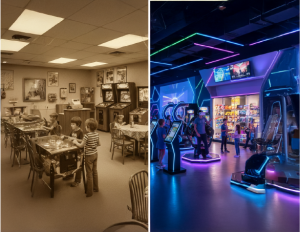 amusement parks offering a full range of entertainment and digital gaming options, prizes and merchandising, and food and beverage (F&B) operations. Moreover, some of these FECs are so big and diverse that the term ‘miniature’ does not apply.
The evolution of FECs into “mini amusement parks” is no accident. Instead, it is this industry’s reaction to major entertainment brands like Disney’s and Universal’s creation of “urban entertainment centers” (UECs) that linked multiple properties and generated considerable consumer interest. To compete, FECs have had to grow and become more varied themselves.
Add the fact that today’s consumers want richer and more varied entertainment experiences beyond simple games, and one can see why the FEC industry’s trend towards more comprehensive venues is a natural response — especially when so much money is on the line. According to the International Franchise Association, the FEC industry’s 2024 value of $28.85 billion in 2024 is projected to double to $60.90 billion by 2031.
To reap these profits and capture a share of this projected revenue growth, FECs must do everything they can to streamline operations while improving their overall efficiency. But, given the current fragmented way that many FECs are being managed, this is not easy to do. While technologies such as smart cards, NFC, and mobile applications have been shown to enhance customer experiences and improve operational speed, implementing them in FECs running siloed software systems can often make matters worse for everyone concerned. The evolution of this problem, and where it leaves FECs today and going into their future, is the subject of Part One to this white paper. The solution is Part Two
Part One
How FEC systems have evolved over time
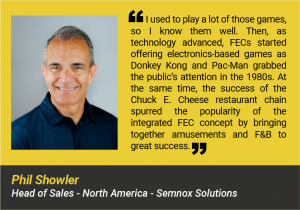
At Semnox Solutions, we’ve had a front-row seat to the evolution of family entertainment centers over the past two decades. Phil Showler, who leads FEC Sales for Semnox in the Americas, brings nearly three decades of hands-on experience in the amusement and attractions industry. As a pioneer in the space, Phil has witnessed firsthand how family entertainment centers have transformed over the years—and how the management systems supporting them have often struggled to keep up with that evolution.“In the early days, FECs were known for electromechanical games in big wooden cabinets, with only two buttons and a joystick,” said Phil Showler.
From these early days well into the 1990s, FECs relied on simple coin- and token-based mechanical systems to run their games and prize distribution systems. Point-of-sale (POS) was handled by manual cash registers, and there was no tracking of player identities or individual sessions. As a result, FEC operators encountered significant challenges such as time-consuming manual tasks and cumbersome workflows on a daily basis.
In the late 1990s, things started to change. Magnetic ‘smart card’ systems made their way into the industry, making payments easier for guests and gaming tracking possible for FEC management. The cards could be reloaded through self-serve card machines on site, reducing the burden on FEC cashiers for customer service. The cashless age had arrived!
At the same time, data from these cards could be used to accurately track daily sales and gaming trends, which was a big boost for FEC managers. They could also be used to provide data for the FEC industry’s first “loyalty programs”. Compared to the manual procedures of the previous decades, magnetic card systems represented a big leap forward for the FEC industry in terms of operational efficiency, data trackability, and improved customer service.
The adoption of such cashless systems, made possible by smart card technology, delivered tangible benefits for FECs. One of these was increased spending by FEC guests, simply because smart cards made it much easier for them to consume games and products. Another was the compilation of their purchasing histories: Now FEC managers could see what their guests liked to spend money on and use this data to create targeted promotions, so that they would spend even more.
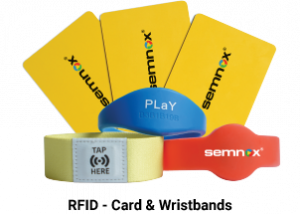
The introduction of RFID cards for “tap to play” at this time marked a turning point in how FECs delivered cashless convenience. Unlike earlier magnetic stripe cards which were prone to wear and tear, difficult for children to handle, and easier to duplicate RFID cards offered a much more reliable and user-friendly alternative. Semnox was the first to pioneer this RFID-based tap-to-play model, enabling guests to simply tap their cards at readers to activate games and attractions. This innovation significantly reduced maintenance issues, extended card life, and set a new standard for ease of use in family entertainment venues.
As technology advanced, the very concept of the family entertainment center began to evolve beyond traditional arcades. Throughout the 2010s and into the 2020s, new venue types such as trampoline parks, indoor play areas, climbing walls, adventure activity centers, AR/VR experiences, sports simulators, and e-sports lounges emerged as standalone FECs in their own right. These specialized destinations broadened the definition of out-of-home entertainment and attracted diverse audiences looking for active and immersive experiences.
This diversification also spurred the adoption of online and onsite booking platforms with integrated waiver management which allowed operators to manage reservations, guest check-ins, and compliance requirements more efficiently.
 With smartphones becoming an integral part of daily life and the COVID-19 pandemic accelerating the push for contactless interactions, the early 2020s saw cashless payment models gain significant momentum. Guests could now load funds, manage balances, and make purchases entirely from their phones. This approach gave operators continued control over the closed payment ecosystem while delivering greater convenience and a frictionless experience to tech-savvy guests. It also opened the door to deeper loyalty engagement by allowing spending patterns, offers, and rewards to be integrated directly within the mobile app environment.
By the end of the 2020s, FECs started transforming into multi-faceted entertainment venues that blended traditional arcades with a wide array of attractions and activities. Operators began incorporating trampoline parks, climbing walls, immersive simulations, and themed adventure zones alongside classic games to create richer, more differentiated experiences. Food and beverage offerings also evolved far beyond basic fast food; many FECs introduced full-service restaurants, specialty cafés, and premium dining options as a core part of their business models. This mix of entertainment and hospitality was designed to encourage families and groups to stay longer, spend more, and return more frequently for a complete leisure experience rather than a single activity. In this pursuit of broader appeal and deeper guest engagement, operators were effectively reshaping the FEC model into a one-stop destination for recreation, dining, and social connection.
Evolution of Open Loop Payment Systems
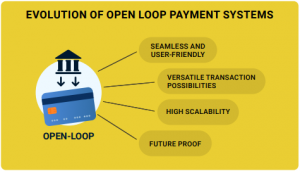 In parallel with closed loop solutions, open loop payment methods began to flourish during this period. FECs increasingly integrated credit and debit card acceptance, QR-based payments such as UPI in India and WeChat Pay in Asia, and popular mobile wallets like Apple Pay and Google Pay. These open loop options made it possible for guests to transact using their preferred payment method without preloading a dedicated card, meeting rising consumer expectations for flexibility and convenience. As contactless and mobile-first behaviors became the norm, supporting a mix of closed and open loop payment systems became essential for modern FEC operations.
Today’s Reality: The Disconnected Operator
With all of these improvements, today’s FECs are light years ahead of their predecessors when it comes to product offerings, customer service, and overall attractiveness to the buying public. Yet the rapid pace of progress has come with a downside: many FECs now operate with siloed management systems, where game operations, F&B, bookings, and loyalty programs are not integrated with one another.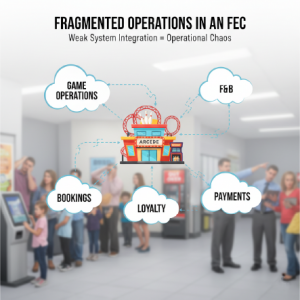
To put it plainly, many FECs are finding that their operational systems have not kept pace with the complexity of their entertainment evolution. While their venues have diversified into a mix of arcades, attractions, and full-service dining, most of their core systems have continued to evolve independently. Card and cashless payment platforms have remained largely unchanged, offering limited improvements beyond their original capabilities. Booking, ticketing, and waiver management solutions have developed as separate systems, often attempting only basic interfaces with other platforms. Meanwhile, food and beverage operations typically rely on standalone POS software that does not integrate seamlessly with gaming or booking data. The result is a patchwork of disconnected systems that do not communicate effectively, creating operational blind spots, inefficiencies, and a fragmented experience for both staff and guests.
This fragmented operational approach stands in stark contrast to contemporary guest expectations. Today’s customers anticipate having access to seamless, digital-first experiences at FECs, much like those they enjoy online or on their gaming consoles. These consumers also expect everything to run smoothly at FECs, no matter what.
“No matter how much the FEC industry has advanced, our guests are always expecting more,” Phil observed. “This is because these guests expect their FECs to be on par with the very best in online gaming, social media experiences, andtop-quality F&B. As a result, FECs have to deliver a ‘WOW Factor’ experience every time that guests come to visit. The varietyand sophistication of the games, prizes, and food have to keep improving, because FECs are now competing with the full range of entertainment that guests have access to.”
This disparity between what guests expect and what FECs can deliver creates a significant “experience gap”. This disconnect is more than a mere internal operational challenge. From the customer’s critical perspective, it is a visible failure on the FEC’s part, manifesting in long wait times and the frustrating need to repeat information to different staff members.
Given that FECs are supposed to deliver fun first and foremost, failing to do so can be an unforgivable sin from a customer standpoint. It certainly doesn’t motivate guests to come back to an underperforming FEC, nor to recommend it to family and friends.
Meanwhile FEC operators grappling with fragmented systems typically encounter several critical pain points that make their lives more difficult, and their FECs less profitable:
 The first pain point is inefficiency. Disconnected systems necessitate the use of manual data transfers. These transfers can lead to duplications of effort, plus significant time wasted by staff searching for information across multiple platforms.
The second pain point is a fragmented customer overview. When customer data is scattered across disconnected systems, FEC operators lack a complete 360-degree view of their guests, which can lead to bad management decisions. Worse yet, different departments may possess conflicting information for the same customer, which can lead to inconsistent customer service, mixed messaging between staff and guests, and ultimately, customer dissatisfaction.
This brings us to data silos, the third FEC pain point. When vital customer data is organized into ‘silos’ that aren’t interconnected, serious errors, omissions, and oversights can occur that can severely hinder effective decision-making. To know what is going on, spot trends, and respond to everything accurately, FEC operators need to be able to see the ‘Big Picture’ at all times. Data silos make this very difficult to achieve, if not impossible.
The last pain point is rising costs. Running several disconnected systems incurs higher expenses for FECs due to separate licensing fees, maintenance, management, and hardware resources. Meanwhile, attempting to integrate such disparate systems using ‘workarounds’ often requires the use of costly custom coding or reliance on third-party middleware.
An End to Disconnected Systems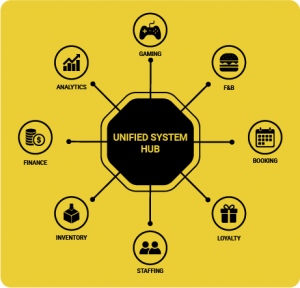
The escalating complexity of FEC operations and the intensifying competition for paying customers mean that operators can no longer afford to rely on workarounds or ad-hoc software solutions. They need a unified FEC-specific software platform that covers all aspects of their operations; one that integrates gaming, F&B, booking, promotion, staffing, inventory, ordering, and all other elements that are needed to keep a modern FEC humming.
Think of a system that integrates and manages an organization’s core business processes, including finance, human resources, operations, supply chain, and customer relationship management. This is the kind of software solution that today’s FECs need to manage themselves effectively, competitively, and profitably. This is the kind of evolution that FECs must undergo to survive and thrive. And this evolution isn’t just about technology; it’s about meeting rising guest expectations and achieving operational clarity.
In Part Two of this white paper series, we’ll share what a unified FEC management system looks like and how it’s already helping forward-looking operators grow faster and smarter.
Part Two
Semnox’s Parafait — A Comprehensive FEC Management Platform
Today’s FECs need a management solution that can bring together their most critical operations into a unified system. This is exactly what Semnox’s Parafait delivers. Parafait is currently being used by more than 2,800 FECs in over 60 countries, helping them run their operations more efficiently and transparently. The Parafait solutions suite has won three IAAPA Brass Ring Awards and is an eight-time winner of the ‘Innovative Product of the Year’ award at various other conferences/shows.
Semnox Solutions built Parafait with a clear vision: to provide FECs with a unified management platform that simplifies operations and reduces fragmentation.
“It made sense for us to create a comprehensive FEC management solution that could go deeper in addressing the industry’s operational challenges,” said Phil Showler. “We saw early on that technology within the FEC industry was converging from gaming and prize-giving to F&B, promotions, and financial systems all moving toward a more connected, data-driven model. Our goal with Parafait has been to align with this trend, creating a platform that evolves in step with operators’ needs and helps them stay ahead as digitization reshapes the industry.”
Over the years, Semnox has continuously expanded the capabilities of Parafait to stay ahead of these changes, from pioneering RFID tap-to-play systems to F&B, multi-location management and reporting, self service options, introducing mobile apps, contactless payments, and advanced online booking and waiver management. This commitment to innovation has ensured that Parafait remains a comprehensive, future-ready solution aligned with how modern FECs operate and grow.
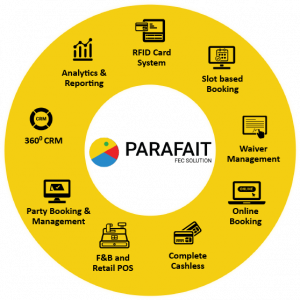
To be precise, Semnox Solutions’ Parafait is a comprehensive, integrated management system designed specifically for family entertainment centers and indoor amusement venues. Functionally, Parafait brings together the core areas of FEC operations into a single, unified platform helping operators transition to a cashless, automated environment that reduces manual processes and drives greater efficiency.
Here is a rundown of Parafait’s key features:
 Cashless Solutions: Parafait’s support of RFID cards/wristbands and readers enables an FEC to offer cashless transactions for games, rides, F&B, and retail sales.
 Parafait’s LuminOS (Linux-based with video display) readers and Xter readers for play areas support quick and seamless ”tap and play” experiences for guests. Meanwhile, Parafait’s wireless debit card readers are portable and easy to use, allowing guests to buy goods and services anywhere in the FEC at their convenience.
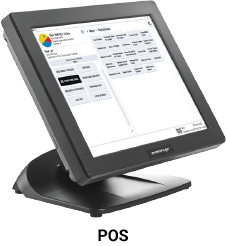
Parafait’s comprehensive cloud-based POS terminals manage all transaction points within an FEC, including card sales, game recharges, food and beverage orders, bookings, and retail purchases all through a single integrated interface. This system makes it much easier for staff to handle different types of sales without switching between separate tools, reducing training time and simplifying daily operations. Because any terminal can process any transaction, operators have the flexibility to move POS units between counters or close selected stations on slower days, optimizing resources and improving service efficiency. Parafait’s mobile POS devices further enhance this flexibility by allowing transactions to be completed anywhere on the floor, helping to reduce queues and improve the guest experience.
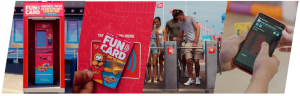
Self-Service Kiosks: Parafait’s ticketing and recharge kiosks allow FEC guests to purchase new RFID cards, check their balances, and recharge their accounts independently, thus acting as “queue busters”. In the same vein, Semnox’s “Kalimprize” redemption kiosks make it easy for guests to browse the FEC’s prize selection and redeem their points for the ones they want
 Booking and Reservation Management: Back in the FEC’s offices, Parafait’s party/event reservations function helps manage party hall bookings and F&B options, and even generates checklists for event hosts. The platform’s online B2C/B2B booking system enables guests to buy tickets and reserve attraction slots and parties through an online portal. Guests can even book specific timed entries and activities for play areas and trampolines, using check-in/check-out features and time-based billing.
Inventory and Redemption Management: Keeping an eye on stock while never having more on hand than needed is a constant balancing act for FECs. Parafait’s centralized inventory management system gives FEC managers complete control over purchasing, receiving, and costing for all stock (perishable and non-perishable), even across multiple locations. It includes an F&B recipe management feature that helps forecast sales and manage perishable stock by tracking ingredients and auto-generating purchase orders. Meanwhile, Parafait’s streamlined redemption keeps an eye on prizes by tracking redeemed items, managing stock reorders, and providing detailed reports to management.
Third-Party Integrations Made Easy: Parafait’s modular and layered system architecture is designed with openness and scalability in mind. The platform offers robust APIs that make it easy to integrate with a wide range of third-party systems whether it’s for E-Sports setups, AR/VR attractions, simulators, or specialty equipment. This ensures that FECs can expand their offerings without being locked into a closed ecosystem. Operators can plug in new entertainment experiences while continuing to manage everything seamlessly through Parafait’s unified backend making it future-ready and flexible for evolving guest expectations.
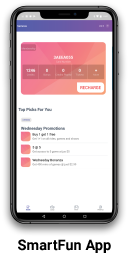 Guest Experience and Engagement: Ensuring that guests have a good time and want to come back is key to any FEC’s success. To make this happen, Parafait’s “SmartFun” mobile app allows guests to directly manage their accounts, top up cards, and view activity history on their own smartphones. On the FEC office side, the platform’s 360° Customer
 Relationship Management (CRM) solution manages loyalty programs, memberships, promotions, and campaigns to keep guests informed and excited about the FEC. For instance, the Parafait loyalty engine rewards guests for their purchases and gameplay to encourage repeat visits, while the achievement module allows FEC operators to reward guests with redeemable points for successful gameplay.
Operational Management: All kinds of details have to be handled in an FEC, and Parafait makes it easier to do so. For example, the platform manages digital waiver signing online, kiosks, or on tablets. Parafait’s play area/activity management integrates hardware (like RFID wristbands) and software to deal with check-in/check-out, time tracking, and security at kids’ play areas and other access points.
Data-Driven Reporting and Business Intelligence : Parafait delivers a powerful reporting framework to help operators run smarter, data-driven FECs. The BizInsights mobile app provides real-time dashboards for quick access to key metrics on the go.
For deeper insights, the Parafait reporting portal offers detailed reports.
 With custom dashboards and scheduled reports, Parafait ensures the right data reaches the right people enabling faster, better decisions across single or multi location operations.
The Payoff: Smoother Operations, Increased Revenues
Taken as a whole, Semnox’s Parafait is a comprehensive, unified solution that addresses the key management and operational challenges of running an FEC. Its automated processes streamline routine tasks, freeing staff to focus more on guests. The result is an enhanced customer experience – strengthened by convenient cashless transactions, self-service options, and mobile apps that put control directly in the hands of visitors.
The payoff for all of these improvements is increased revenue, operational efficiency and guest satisfaction. Parafait empowers FECs to drive higher-value sales through seamless cashless transactions, dynamic promotions, loyalty programs, and efficient F&B management all while improving operational efficiency, tighter control and improved guest satisfaction/experience. Operators can easily create combo offers and value packages that bundle gameplay, food, and attractions, increasing average spend while enhancing perceived value for guests.
The platform is also built to scale, supporting multi-location management from a central office with consistent reporting and controls. Add in Parafait’s automation, real-time analytics, and secure infrastructure, backed by 24/7/365 global support, and it becomes clear why Semnox Parafait is the all-in-one management solution FECs need to grow profitably and sustainably.
 Staying Ahead of the Curve
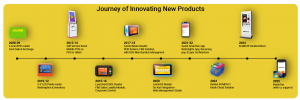
What sets Semnox apart is not just what we built – but when and why we built it. As FECs evolved from simple arcades to complex, multi-experience venues, we continuously expanded Parafait to keep pace with these shifts. From pioneering RFID tap-to-play systems in the early 2000s to enabling mobile apps, value packaging, online booking, and multi-location scalability, Parafait has been developed in direct response to real-world operator needs. While many competitors offer fragmented tools or legacy systems with minimal updates, Parafait stands out as a platform purpose built for the modern FEC—ready for what comes next.
“This is why 2,800 FECs worldwide are using Parafait today, and more keep signing on,” Phil Showler concluded. “We have the award-winning solutions that FECs and other amusement attractions need today.”
The bottom line: Semnox’s Parafait is a future-ready solution for FECs, enabling operators to run leaner, smarter, and more connected businesses.
Find out why hundreds of venues trust us to automate, scale and delight.
www.parafait.com | parafait.enquiry@semnox.com

A seasoned sales leader with deep roots in the out-of-home entertainment and attractions industry, Phil Showler brings decades of commercial expertise to the Parafait team at Semnox Solutions. With a strong focus on strategic growth, partner engagement, and market expansion, he plays a pivotal role in driving Parafait’s global presence.
At Parafait, Phil leads sales initiatives for a robust suite of venue management solutions—ranging from cashless systems and self-service kiosks to access control and integrated POS. His customer-first approach, coupled with industry insight, helps amusement parks, FECs, and leisure venues implement future-ready technology that elevates operations and guest satisfaction.